
The short answer
To make an ai clone of yourself, record a short clean video of yourself talking to the camera, record the consent clip the tool asks for, clone your voice from clean audio, test the twin on a script you know well, and fix the source before you pay for volume.
What do you need ready before you start?
You need three things ready before you open any tool. You need a quiet room with plain light on your face, a phone or camera that records clear video, and a short script in your own normal words. Most owners already own all three, and the owners who stall are rarely missing gear. They stall because they sit down with no script and no quiet room, and the first take sounds like a voicemail recorded in a car.
Pick the look you want the twin to wear for months, because that look is what buyers will see in video after video. Wear what you wear on a sales call, sit or stand the way you sit or stand with a client, and keep the background plain and bright. HeyGen, in its digital twin guide read in November 2026, says a twin on its newest engine can be built from about 15 seconds of video, and processing often finishes in about 10 to 20 minutes. Synthesia asks for more source, about two to three minutes of footage plus a consent video on paid plans, and its personal avatar can take until the next day. The short minimum is a floor, not a goal. A longer clean take gives the tool more of your real movement to learn from.
Charley Cash, founder of Setters and Closers Co., tells owners to judge the plan before the tool. “Record the take you would send to a buyer today, not a take you hope the software will fix later. The clone copies what you give it, flaws included, so give it your best normal day, not your best perfect day.”
What is step one, setting up the room and the camera?
Step one is the room, and it decides more of the final quality than the plan price does. Face a window or a soft light so both sides of your face read clear, put the camera at eye level, and leave a little space above your head in the frame. Turn off anything that hums, clicks, or echoes, because the voice clone learns room noise as part of your voice if you let it sit under your words.
Frame yourself the way your videos will run. Most owner videos run tall on phones, so test one tall take and one wide take and keep the one your main platform uses. Look into the lens, not at your own picture on the screen, and keep your hands in the frame only if you talk with your hands in real life. A twin whose hands never move looks calm to the maker and stiff to everyone else.
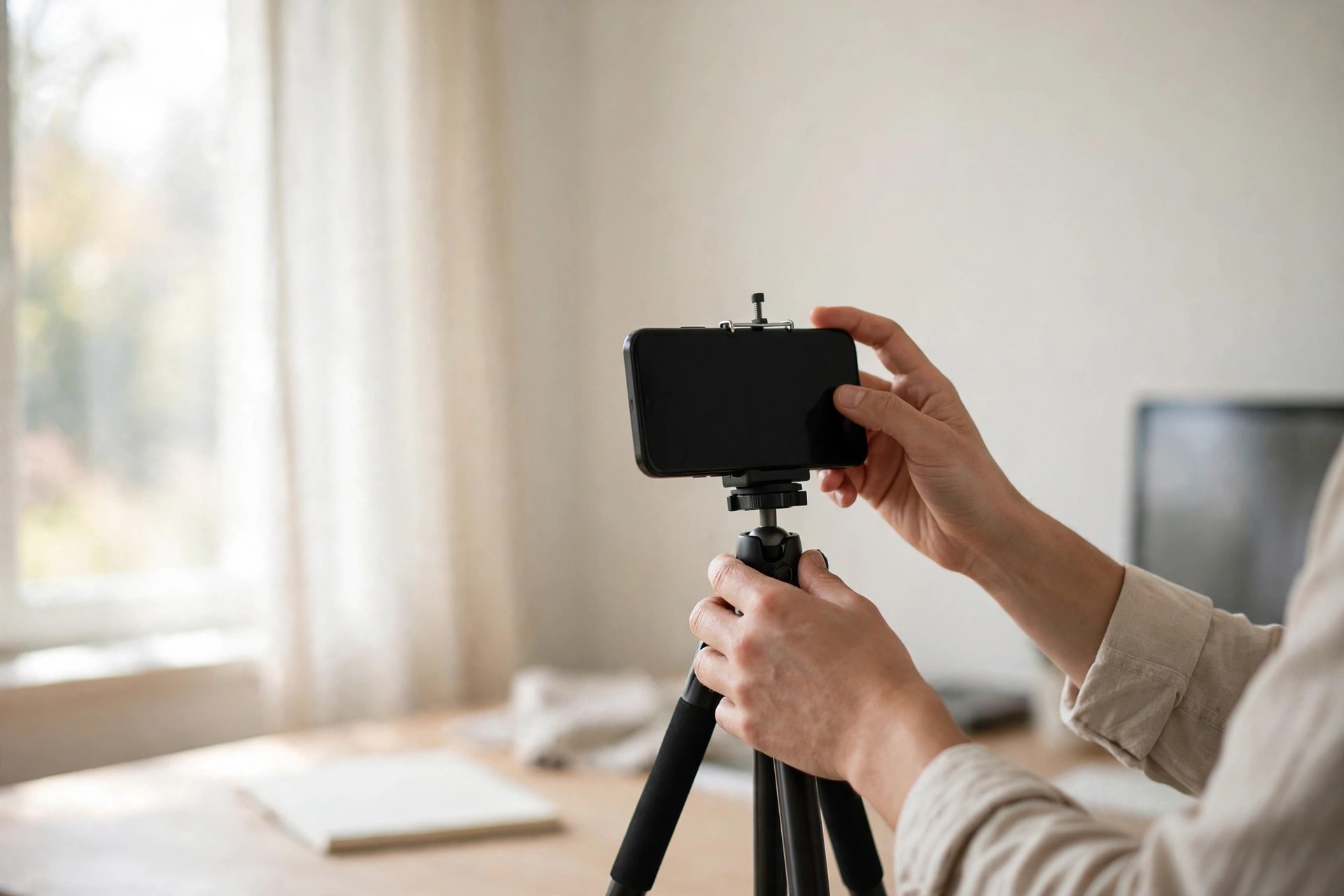
What is step two, recording the source video?
Step two is the source recording, and you should record more than the minimum even when the tool allows less. Record two to three minutes of you talking about a topic you know cold, like why you started the business or how your offer works. Speak at your normal pace, smile the way you smile with a client, and leave short pauses between thoughts. Those pauses teach the twin where your sentences end, and a twin that never pauses sounds rushed even when the words are right.
If the first take has a bad word, a loud sound, or a long stare, record again instead of editing around it. The source is the one input you fully control, and every later video inherits it. One owner we worked with recorded five takes in twenty minutes and used the fourth, because the first three carried a tight jaw from trying too hard. The fourth take sounded like a person. The twin built from it sounded like a person too.
What is step three, the consent clip and the voice clone?
Step three is consent, and no honest tool skips it. You record a short clip where you say, on camera, that you are you and that you agree to be cloned by that tool. HeyGen words its consent line with your full name and a plain statement that you allow the footage to be used to build your avatar, per its clone guide read in November 2026. That clip protects you as well as the platform, because it is proof that the face and voice were given, not taken.
The voice clone comes from clean audio of the same session or a short added recording. HeyGen offers an instant voice clone from up to 60 seconds of audio, ready in minutes, and a professional voice clone trained on at least 20 minutes of recordings as a paid add on listed at 29 dollars a month per voice in its help center, read in November 2026. Read your test audio aloud before you upload it. If you mumble a word in the source, the clone will mumble that word in every video that uses it. Fix the source, not the output.
What is step four, testing the twin before you trust it?
Step four is the test render, and it is where honest owners save themselves months of weak posts. Paste a script you have said out loud many times, render a full two minute video, and watch the whole thing with the sound on and then once with the sound off. With sound on, listen for flat spots, odd stress on common words, and any name or price the twin says wrong. With sound off, watch the mouth, the eyes, and the hands for loops or freezes that pull your eye away from the words.
Our team learned this step the hard way across a larger body of work. Across 311 businesses, our setters and closers have booked 22,283 appointments, closed 7,411 new clients, and helped collect 11 million dollars in cash. Content feeds that pipeline only when buyers believe the person on screen. Early twin tests in our work were judged on ten second clips and passed too fast. Full length tests caught the weak spots the short clips hid, like a blink pattern that repeated and a smile that arrived half a second late. We now treat a full two minute test as the gate, and a twin that fails it gets a new source recording, not a lower standard.

How much does it cost to make an ai clone of yourself?
You can test for free, and you pay when you need volume, length, or a cleaner grade. HeyGen includes one digital twin slot on its free plan with watermarked videos, and its Creator plan costs 29 dollars a month, or 24 dollars a month billed yearly, for 600 credits, per its pricing and clone guide read in November 2026. Its top twin engine uses 48 credits a minute, so 600 credits cover about 12 minutes of top grade video a month. Synthesia lists Starter at lower monthly figures that change by billing term, with personal avatars on paid plans, and BIGVU puts its AI Twin of face and voice on its Max plan listed at 49 dollars a month billed annually, per its pricing page read in November 2026.
| Route | What you pay in 2026 | What you get | Best first use |
|---|---|---|---|
| HeyGen Free | 0 dollars | One digital twin slot, watermarked test videos | Prove the twin looks and sounds like you |
| HeyGen Creator | 29 dollars a month, or 24 billed yearly, for 600 credits | Twin plus voice clone, videos up to 30 minutes | Daily short videos at a steady pace |
| HeyGen Professional Voice Clone add on | 29 dollars a month per voice, plus a paid plan | Voice trained on 20 plus minutes of audio | Owners whose voice carries the brand |
| Synthesia paid plan | Paid plan required, price varies by term | Personal avatar from two to three minutes of footage plus consent | Teams already working inside Synthesia |
| BIGVU Max | 49 dollars a month billed annually | AI Twin of face and voice inside a recording app | Owners who still film some videos by hand |
Here is worked math for a normal owner month. Say you post ten videos and each one runs ninety seconds, so you need 15 finished minutes. On the HeyGen top engine at 48 credits a minute, 15 minutes uses 720 credits, which is over the 600 credit Creator month, so you either step up, shorten the videos, or save the top engine for your best scripts and use a lower credit engine for daily posts. On a mid grade engine the same month can fit inside Creator. The lesson is plain. Price the credits for your real pace before you fall in love with the top grade demo.
Hidden costs are time costs in most cases. Script writing takes longer than rendering. Review takes longer than owners expect, because a twin video still needs a human eye before it posts. Extra looks, extra voices, and added team seats can each carry their own fee on some plans. If you want the full build mapped to your offer and your pace, book a game plan call at https://www.settersandclosers.co/#booking and we will walk the steps in order for your business.
How do you make your first real video with the twin?
Your first real video should be short, useful, and easy for you to judge. Pick one question buyers ask you every week and answer it in about 150 words of plain speech. Write the script the way you talk, read it aloud once, cut any line you would never say on a call, and only then paste it into the tool. Add captions in the tool or in your editor, keep the opening line as the answer to the question, and post it with the AI label the platform asks for.
Wyzowl, in its State of Video Marketing 2026 survey of 266 marketers and consumers fielded in late 2025, found that 91 percent of businesses use video as a marketing tool and 93 percent of video marketers call video an important part of their strategy. Wyzowl reported in 2025 that 87 percent of people have been convinced to buy a product or service after watching a video. HubSpot, in its 2025 State of Marketing report, found short form video was the format most often named by marketers as giving the highest return, at about 21 percent of those surveyed. Those numbers explain why a short honest twin video posted today beats a perfect filmed video planned for next month.
One client told us after his first week, “The twin said my own words better on day three than I said them on camera on day one, because the script forced me to get clear.” That clarity is a side gain owners rarely expect. Writing for a twin makes you write the way you should have been talking all along, short and plain and in order.
Should you use HeyGen, Synthesia, or another tool to clone yourself?
Our position is that most solo owners and small teams should start on HeyGen, because the free twin slot and the short source path let you judge a real twin today with no spend. Start there, run the full test, and count your credits against your real posting pace. Move only when a clear limit bites, like a team workflow you already run in another tool or a voice grade your brand truly needs.
Choose Synthesia when your team already makes training or course video inside it and the personal avatar keeps everyone in one place. Choose BIGVU when you still want a teleprompter and a recording app as your main habit and the twin is a backup for busy weeks. Choose a done for you build when your time costs more than the service fee and you want a team to own scripts, renders, captions, and posting while you approve. In every case the tool matters less than the source take and the test gate. A clean source on a plain plan beats a weak source on the top plan.
What mistakes do people make when they clone themselves?
The first mistake is recording the minimum and calling it done. Fifteen seconds can start a twin, but it gives the tool very little of your real pace, your pauses, and your normal face. The second mistake is cloning in a look you never wear in real life, so buyers meet one person on video and a different person on the sales call. The third mistake is skipping the full test and posting the first render because the first ten seconds looked fine.
Red flags in any service are plain. A service that offers to clone someone else from found video with no consent step is a hard no. A service that will not state its credit or minute math in numbers is hiding the real price. A service that claims you own nothing and can take the twin away with no export path should be read with care before you build a content habit on it. The Federal Trade Commission final rule on fake reviews and testimonials, announced in August 2024, bans praise that pretends to come from people who do not exist or never used a product, with civil penalties of up to 53,088 dollars per knowing violation. A twin reading fake praise is still fake praise, with your face on it.
Frequently asked questions
How long does it take to make an ai clone of yourself?
Most owners finish the room setup, the source recording, and the consent clip in under an hour. HeyGen processing often finishes in about 10 to 20 minutes on its newest engine, while Synthesia personal avatars can take until the next day, so plan on testing the same day or the next morning.
How much video do you need to record to clone yourself?
HeyGen can start a twin from about 15 seconds on its newest engine, but a two to three minute clean take gives the tool more of your real pace and face to learn from. Synthesia asks for about two to three minutes of footage plus a consent video on paid plans.
How much does it cost to make an ai clone of yourself?
Testing can cost nothing, because HeyGen includes one twin slot on its free plan with watermarked videos. Paid work starts at 29 dollars a month for HeyGen Creator with 600 credits, and voice or studio grade add ons cost more, so price your real minutes before you choose a plan.
Will people know the video is an ai clone of yourself?
Many viewers will notice small signs, and platforms ask you to label AI made video in any case. Most buyers accept a clone when the words are honest, the owner is open about the tool, and the same person shows up live on calls. Trust falls when a business hides the clone.
Can you clone yourself with just your phone?
Yes, a modern phone in a quiet bright room is enough for a first twin on the main tools. Put the phone at eye level, face the light, record clean sound with no room echo, and record more than the minimum so the tool has real movement and pace to learn from.
What should you never let your clone say?
Never let your clone give praise from clients who never gave it, claim results you cannot prove, or promise prices and outcomes you would not promise on a live call. The FTC bans fake testimonials, and a clone reading your script is your claim with your name and face attached to it.
Ready to make a clone that posts while you sell?
Start with one clean take, one consent clip, and one full test video on a script you know cold. If the twin holds your trust for two full minutes, you have a working clone and a daily posting path that no longer waits on a free afternoon.
Book a free game plan call: https://www.settersandclosers.co/#booking
About the author
Charley Cash is the founder of Setters and Closers Co. He helps coaches, consultants, and agencies grow with trained appointment setters and closers, and with the systems those reps work inside. His placements have supported 311 businesses and 11 million dollars in cash collected.
Sources
- HeyGen, How to Clone Yourself With AI digital twin guide, read November 2026, 15 second source on Avatar V, consent wording, processing in about 10 to 15 minutes, free plan one twin slot, Creator at 29 dollars a month or 24 billed yearly for 600 credits, top engine at 48 credits a minute.
- HeyGen help center, Professional Voice Clone, read November 2026, instant clone from up to 60 seconds of audio, professional clone from at least 20 minutes of recordings, add on at 29 dollars a month per voice.
- Synthesia personal avatar guidance summarized in November 2026 roundups, two to three minutes of footage plus a consent video on paid plans, avatar ready by the next day.
- BIGVU pricing and digital twin guide, read November 2026, AI Twin of face and voice on the Max plan listed at 49 dollars a month billed annually.
- Wyzowl, State of Video Marketing 2026, survey of 266 marketers and consumers fielded in late 2025, 91 percent of businesses use video, 93 percent of video marketers call video important.
- Wyzowl, State of Video Marketing 2025, 87 percent of people have been convinced to buy after watching a video.
- HubSpot, State of Marketing 2025, short form video most often named as the format giving the highest return, at about 21 percent of marketers surveyed.
- Federal Trade Commission, final rule banning fake reviews and testimonials, announced August 2024, civil penalty of up to 53,088 dollars per knowing violation.
- Setters and Closers Co. placement records: 311 businesses scaled, 22,283 booked appointments, 7,411 new clients closed, 11 million dollars cash collected.
Related posts
- AI Clone Video Service: What a Digital Twin for Business Owners Includes and Costs
- AI Clone Videos: Post Daily Without Filming
- AI Appointment Setter: What It Is, How It Books Calls, and What It Costs
- AI Voice Receptionist for Business: What It Does, What It Costs, and When It Beats a Human Receptionist
Add Setters and Closers as a preferred source on Google and our new posts show up first for you.